When Claude Code tells you the limit is reached, switch that session to an API key. Per-token billing replaces the plan limit.
This is Anthropic's documented behavior, not a loophole. Their gateway page says that while a gateway credential is active, requests carry that credential instead of your claude.ai login, and "the subscription's usage limits don't apply to them." The bill goes to whoever owns the key.
Your options when the limit hits
| Option | What changes | What you pay | Setup |
|---|---|---|---|
| Wait for the reset | Nothing. The "limit reached, resets at" message gives the time | Nothing extra | None |
| Anthropic Console API key | Same Claude models, billed per token | Anthropic's API rates | One credential variable |
| An Anthropic-compatible endpoint serving another model | A different model, such as Kimi K3.1 Pro | $1.80 in / $9.00 out per 1M tokens on Wallaby | Base URL, credential, model |
| Stretch the plan | /clear between tasks, Sonnet instead of Opus for routine work |
Nothing extra | Habit |
If you need Claude itself, take the Console key. Use the third row when the work is routine and cost is the reason you hit the cap: the plan stays untouched for the hard problems, and a cheaper open-weight model carries the rest.
The variable people miss
Setting ANTHROPIC_BASE_URL alone changes nothing about your limit. Anthropic's docs are explicit: with only the base URL set, your saved claude.ai login stays the active credential, so its usage limits and billing still apply.
You need a credential variable as well:
ANTHROPIC_AUTH_TOKENsends the key asAuthorization: Bearerand takes over immediately.ANTHROPIC_API_KEYsends it asx-api-keyand asks you to approve it once in interactive mode.
Then check. Run /status inside the session (Anthropic's connection checklist uses the same test). An Auth token line naming ANTHROPIC_AUTH_TOKEN means the key is in charge. A Login method line naming your claude.ai account means you are still drawing on the plan.
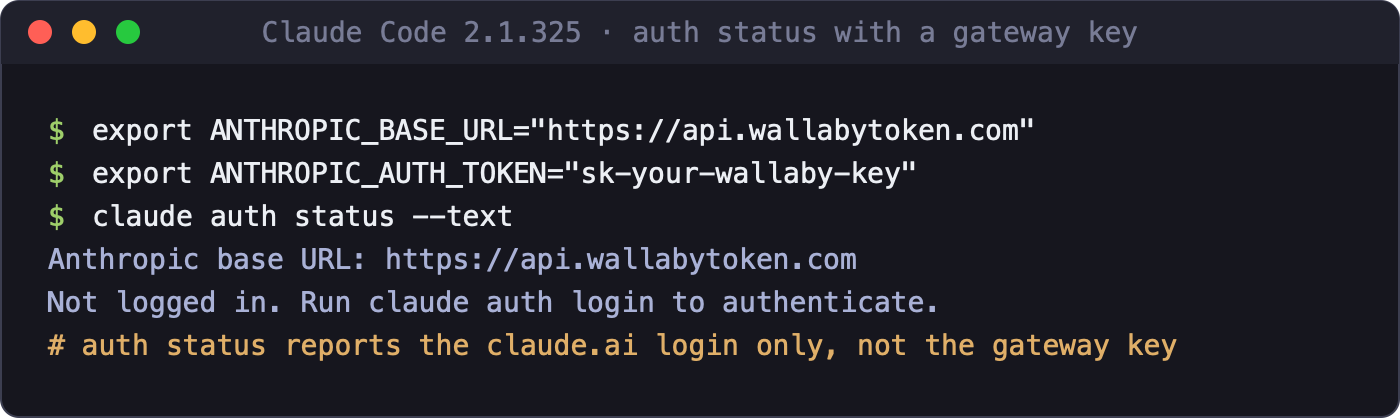
One check that does not work: claude auth status. With both variables set, Claude Code 2.1.325 still told us we were not logged in. That command reports the claude.ai login only, and the gateway key worked anyway; every test below ran on it.
Switch one shell, keep the plan everywhere else
Open a new terminal for the overflow work, so your normal shell keeps using the subscription:
export ANTHROPIC_BASE_URL="https://api.wallabytoken.com"
export ANTHROPIC_AUTH_TOKEN="sk-your-wallaby-key"
export ANTHROPIC_MODEL="kimi-k3.1-pro"
export ANTHROPIC_DEFAULT_HAIKU_MODEL="kimi-k3.1-pro"
claude
The base URL has no /v1. Claude Code appends /v1/messages itself, and a stray /v1 returns 404 on every request.
The fourth line is insurance. The environment variable reference says Claude Code uses ANTHROPIC_DEFAULT_HAIKU_MODEL for background work, and it now marks the older ANTHROPIC_SMALL_FAST_MODEL as deprecated.
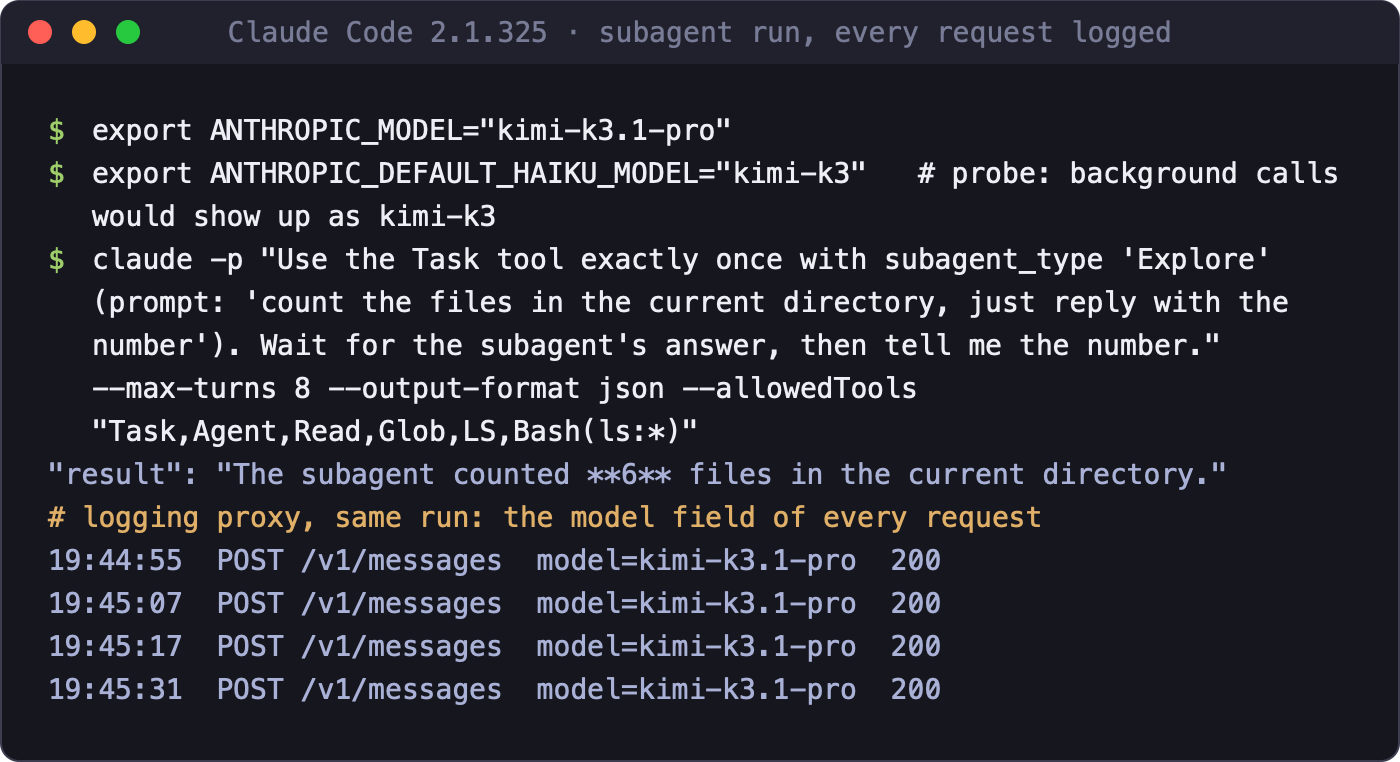
We put a logging proxy between Claude Code 2.1.325 and our endpoint and gave it a task that spawns an Explore subagent. Every request carried kimi-k3.1-pro, the subagent included. To catch background calls we then pointed the Haiku variable at a different model, kimi-k3. None arrived, in two runs. Print mode made no Haiku-class calls at all, so keep the line for interactive sessions. Our October wire test on 2.1.300 found the same: nothing leaked to a Claude model.
One more trap: /model opus and /model sonnet resolve to ANTHROPIC_DEFAULT_OPUS_MODEL and ANTHROPIC_DEFAULT_SONNET_MODEL. In the overflow shell, either set those to the Kimi ID too or leave /model alone.
Pick up where you stopped
claude --continue reopens the most recent conversation in the current directory.
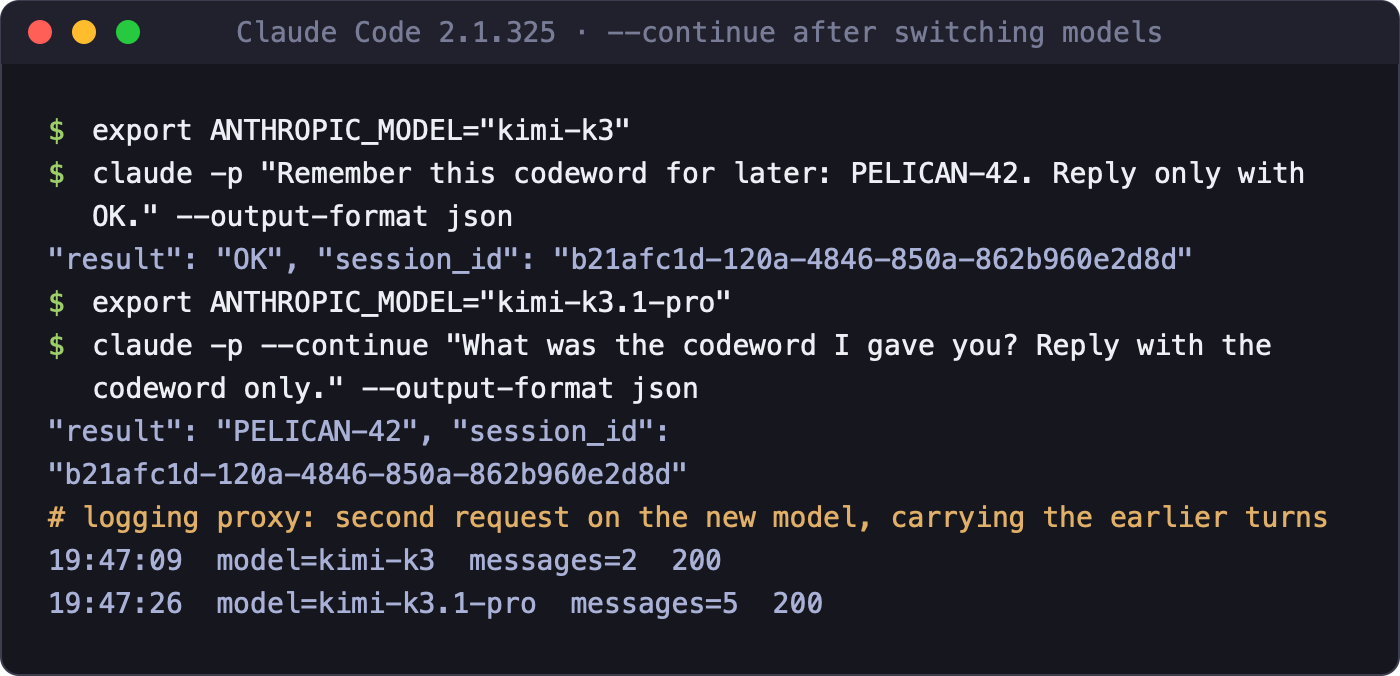
It does not care which model wrote the history. We started a session on kimi-k3, gave it a codeword, switched ANTHROPIC_MODEL to kimi-k3.1-pro and ran --continue. Same session ID, codeword returned, and the proxy showed the new request carrying the earlier turns.
We have not tested resuming a conversation that began on your Claude subscription. If --continue errors there, start a fresh session in the overflow shell and point it at the files you were working on.
What it costs
| Kimi K3.1 Pro on Wallaby | Kimi K3 on Wallaby | |
|---|---|---|
| Input | $1.80 | $2.55 |
| Cached input | $0.18 | $0.255 |
| Output | $9.00 | $12.75 |
Per 1M tokens. K3.1 Pro is 10% below the official list price and K3 is 15% below.
Read your spend from the Wallaby dashboard, not from Claude Code. The client prices a model it does not recognize with its own table. For the session in the next section, Claude Code reported $0.34. The dashboard charged $0.15, and it itemizes every request at the rate you actually pay.
A full session in the overflow shell
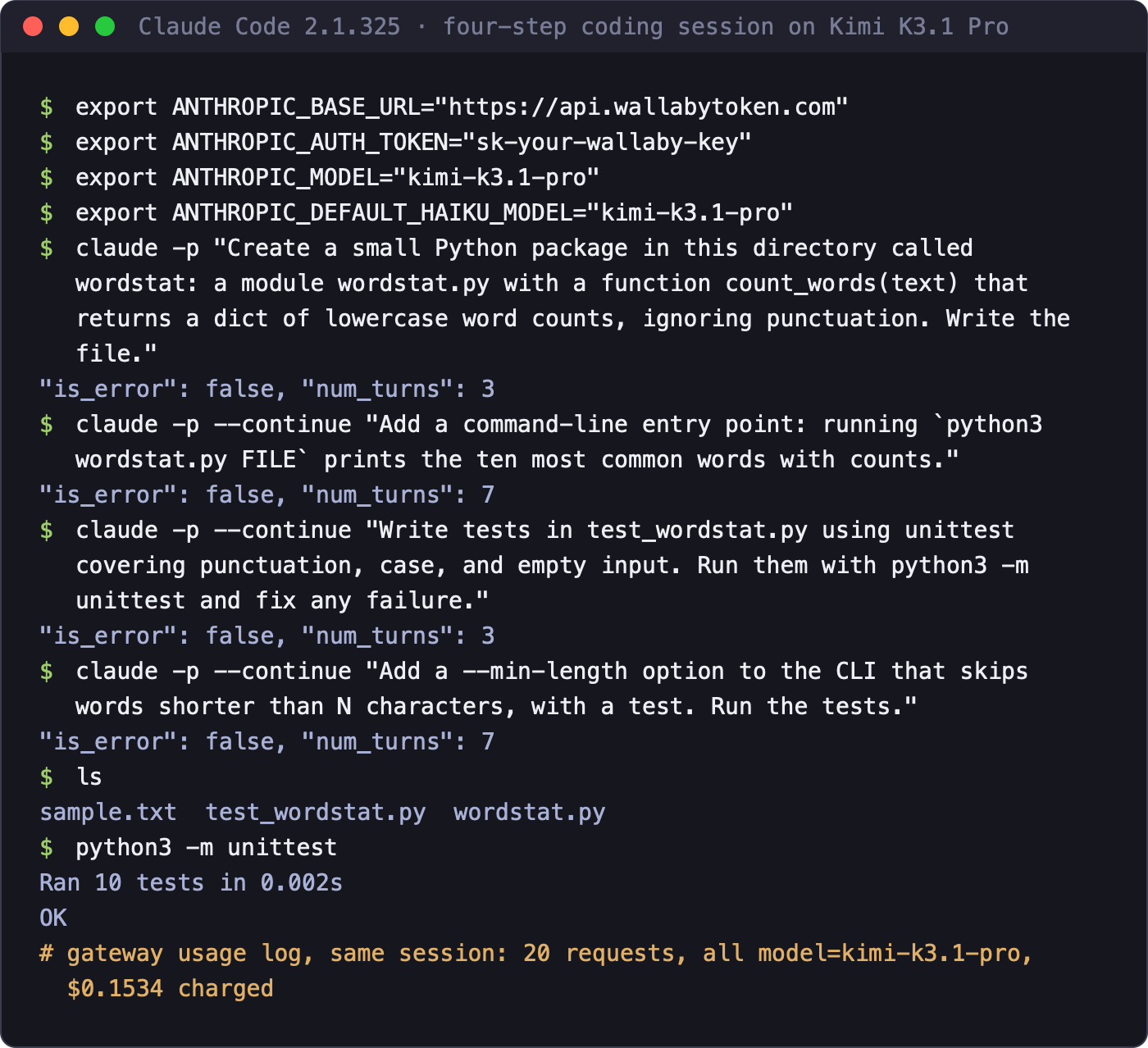
The probes above show where requests go. They do not show whether you can get work done. So on November 16 we gave the overflow shell a real task: build a small Python package, add a command-line entry point, write unit tests, then add a --min-length option with its own test. That was four claude -p calls, the last three with --continue.
It held up. Claude Code wrote wordstat.py and test_wordstat.py, edited both as the task grew, and ran the tests itself. Our gateway log shows 20 requests for the session, every one on kimi-k3.1-pro. python3 -m unittest passes all 10 tests.
Cached context is why it stays cheap. Of the 287,658 input tokens in that session, 255,996 were cache hits billed at $0.18 per 1M.
When you get your plan back
Close the overflow terminal, or unset the four variables. /status should show your claude.ai login method again.
Kimi K3.1 Pro is not Claude, and Claude Code is built around Claude models, so a tool-calling pattern that never failed on Claude can fail here. When we first set this up in September, Claude Code also printed a warning that the model was not in its built-in catalog. The warning was cosmetic; the session ran.
Get a key
Create an account at wallabytoken.com; new accounts start with $0.50 in free credit, and an eligible first top-up is $5. Setting Claude Code up from scratch instead? The five-minute setup guide covers it.