Claude Code supports custom model endpoints through documented environment variable overrides, which makes it possible to run third-party models such as kimi-k3, an open-weight reasoning model from Moonshot AI. This tutorial covers the configuration, verification, and pricing. Disclosure: Wallaby Token sells API access to kimi-k3, and the examples below use our endpoint.
What you need
- A Wallaby Token API key. Create an account at wallabytoken.com; new accounts receive $0.50 in free credit.
- Claude Code installed. Refer to the official documentation for installation instructions.
Setup
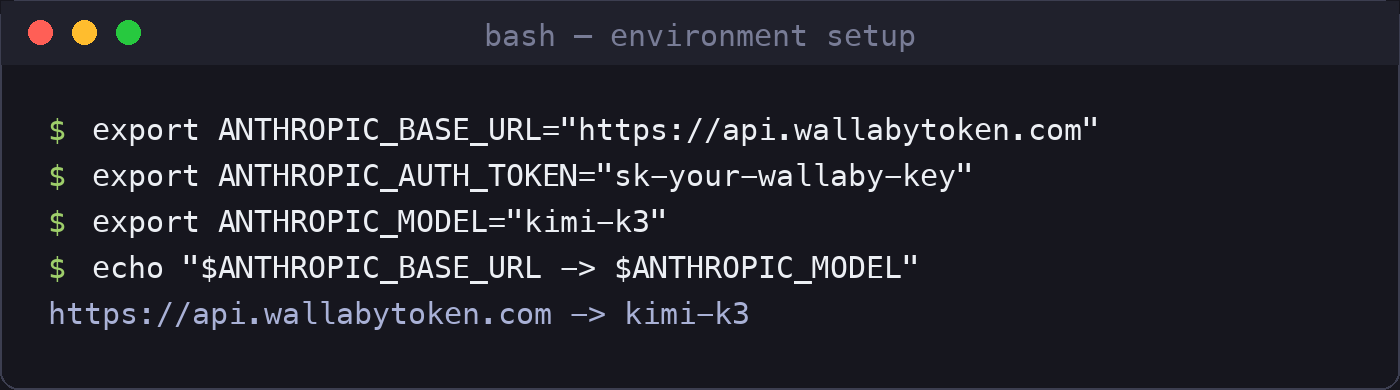
Claude Code reads its model endpoint from environment variables. The documented overrides for pointing it at a third-party gateway are ANTHROPIC_BASE_URL, ANTHROPIC_AUTH_TOKEN, and ANTHROPIC_MODEL.
- Set the three variables in your shell:
export ANTHROPIC_BASE_URL="https://api.wallabytoken.com"
export ANTHROPIC_AUTH_TOKEN="sk-your-wallaby-key"
export ANTHROPIC_MODEL="kimi-k3"
Note the base URL has no /v1 suffix — Claude Code appends /v1/messages itself. Including /v1 produces a 404 on every request.
-
Persist them by appending the same lines to your shell profile (
~/.bashrc,~/.zshrc, or equivalent), then reload the profile or open a new terminal. -
Start a session:
claude
Compatibility notes, verified end-to-end on 2026-09-09 against a live Claude Code CLI: our gateway speaks the Anthropic messages format natively, and the three-variable setup above completes real sessions. Two things to expect: Claude Code prints a cosmetic warning that kimi-k3 is not in its built-in model catalog (safe to ignore; the request still runs, with auto-compact assuming a 200k context window), and a 404 response almost always means the /v1 suffix described above.
Verify the configuration
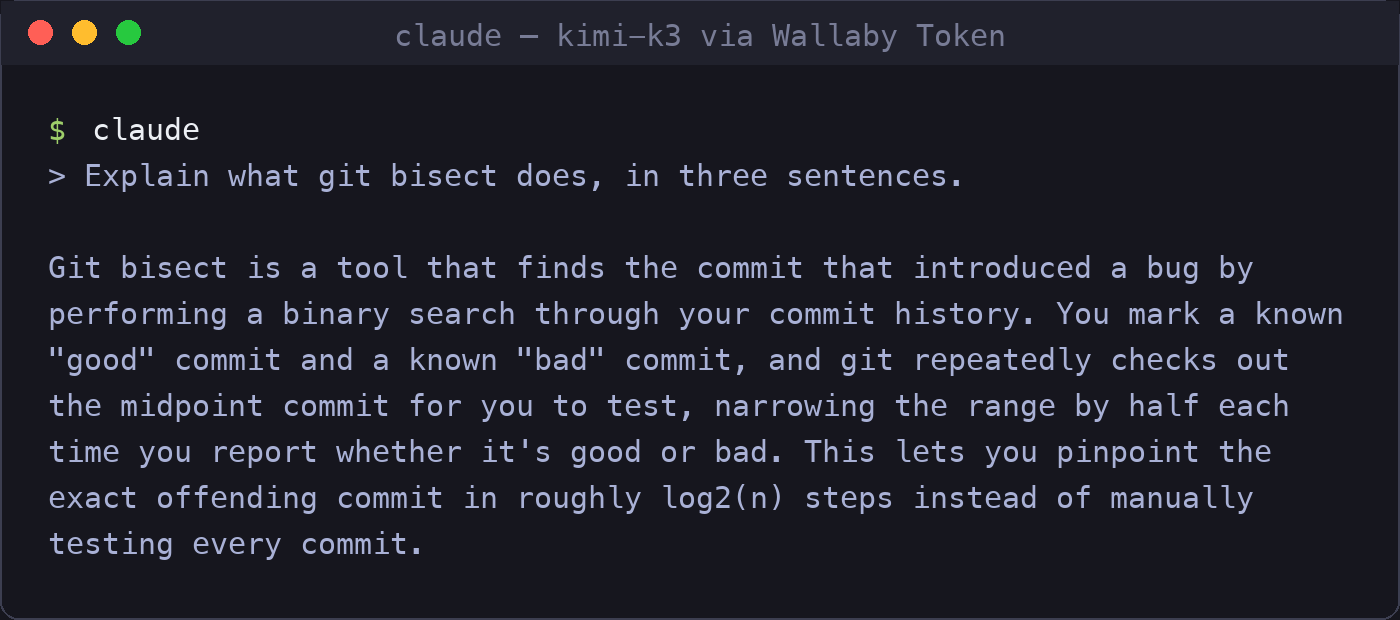
In the Claude Code session, submit a minimal prompt:
Explain what git bisect does, in three sentences.
A working setup produces a streamed, coherent three-sentence answer with no authentication or connection errors. A 401 response indicates the API key is incorrect or missing; a 404 almost always means the base URL carries a stray /v1 suffix — it must be exactly https://api.wallabytoken.com. You can also ask the model to identify itself; it should respond as kimi-k3.
Pricing
All prices are per 1M tokens.
| Wallaby | Official list | |
|---|---|---|
| Input | $2.70 | $3.00 |
| Cached input | $0.27 | $0.30 |
| Output | $13.50 | $15.00 |
Our rate is a flat 10% below the official list price, every day — see how our Kimi K3 pricing compares across 18 providers. The $0.50 trial credit covers approximately 185,000 input tokens at that rate, which is sufficient to complete this setup and run an initial evaluation. The minimum top-up is $20.
What we do differently
Three decisions distinguish Wallaby Token from other API platforms. First, billing is transparent and itemized per request, so every charge can be reconciled against actual usage. Second, we serve open-weight models only; we do not carry closed proprietary models. Third, we do not chase short-lived model hype cycles — we add models when they demonstrate durable value, not when they trend.
Get started
Create an account at wallabytoken.com, receive $0.50 in free trial credit, and generate an API key. Per-request billing settles in seconds, so the usage from your first test prompt appears in your dashboard almost immediately. Prefer a different harness? Hermes takes four lines of YAML. Adding REA for reverse engineering on top? It rides on the same three variables. Wondering what the subagents run on? We put a logging proxy on the wire and checked. Noticed your context compressing after idle time? That is Claude Code's idle compaction, gated server-side — here is what we found.