Most coding agents now expose a "reasoning effort" dial, and most advice about it is vibes: turn it up when the task feels hard. We wanted to know what each click of the dial actually buys, so we ran the same task four times — same prompt, same workspace, same agent — changing only the effort tier. Every request went through our own gateway, so each run generated a real, itemised bill, the same kind our customers get. The short version: the cheapest run caught the headline findings, and the most expensive run was the one called "None."
Disclosure: Wallaby Token operates an OpenAI-compatible inference API and sells Kimi K3, the model used below. That is also why we can show you exact bills: the traffic was metered like any customer's.
The setup
The task: review an open-source agent memory system (AGENTS.md, MEMORY.md, NOW.md, INDEX.md, PROMPT.md, plus templates and skills), then write a critical review to memory-review.md — what breaks first for a new user, what is over-engineered, top three improvements ranked by impact, citing file and line for each finding.
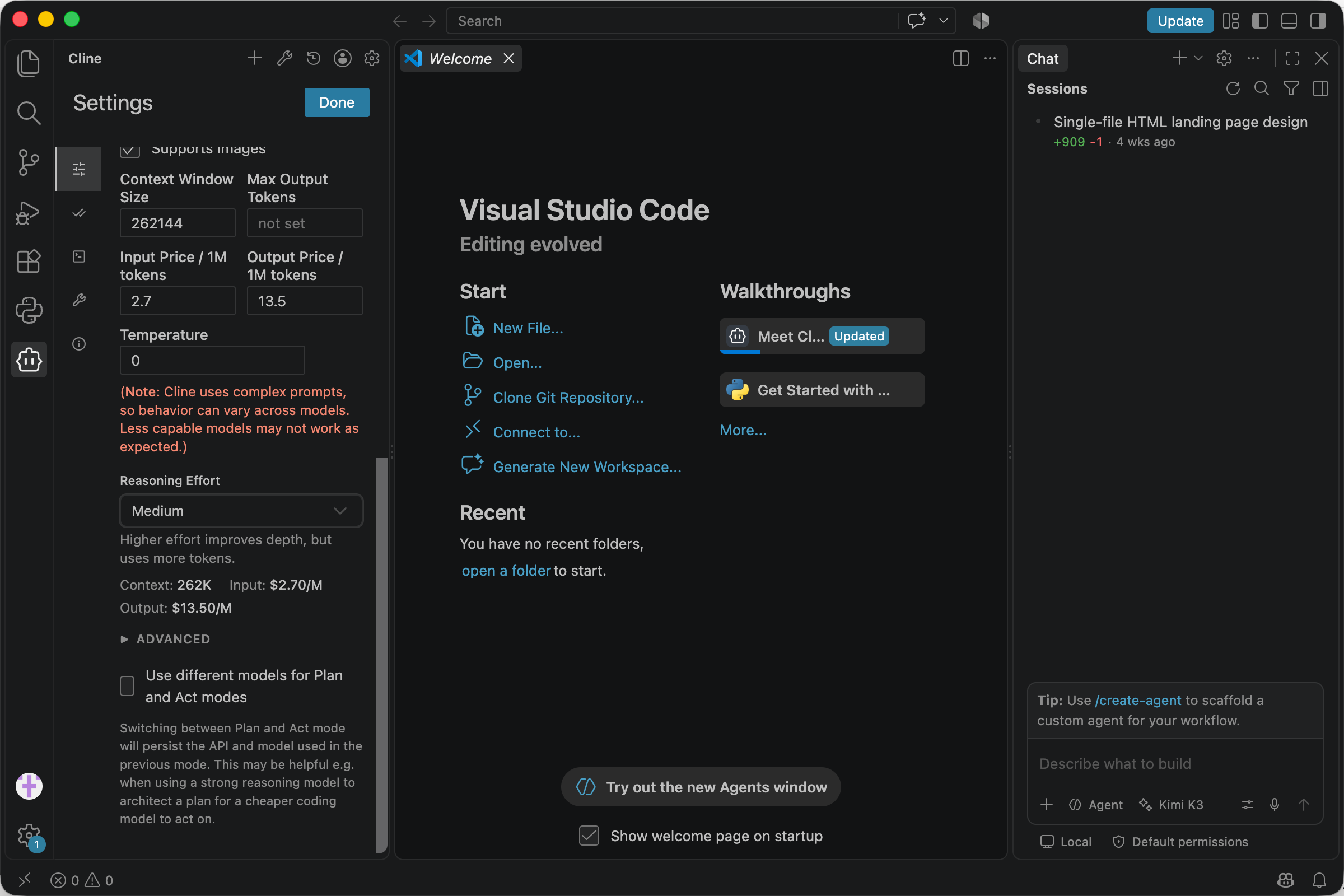
The rig: Cline 4.1.22, model kimi-k3, connected through Cline's built-in Wallaby provider. A fresh copy of the repository for each run, verified clean with git status before starting. All four runs finished autonomously — the agent read the files, actually executed the repo's own health-check and reconciliation scripts, and wrote the review.
The bill
Numbers below are from the gateway's billing records, not from the client's display (the difference matters — keep reading).
| Effort tier | Requests | Output tokens | Gateway charge | Review length | Wall-clock time |
|---|---|---|---|---|---|
| Low | 24 | 9,644 | $0.4182 | 38 lines | 6 min |
| Medium | 32 | 17,094 | $0.7240 | 92 lines | 8.5 min |
| Extra-high | 19 | 23,806 | $0.8557 | 120 lines | 9 min |
| None (no budget) | 29 | 35,946 | $1.4260 | 107 lines | 12 min |
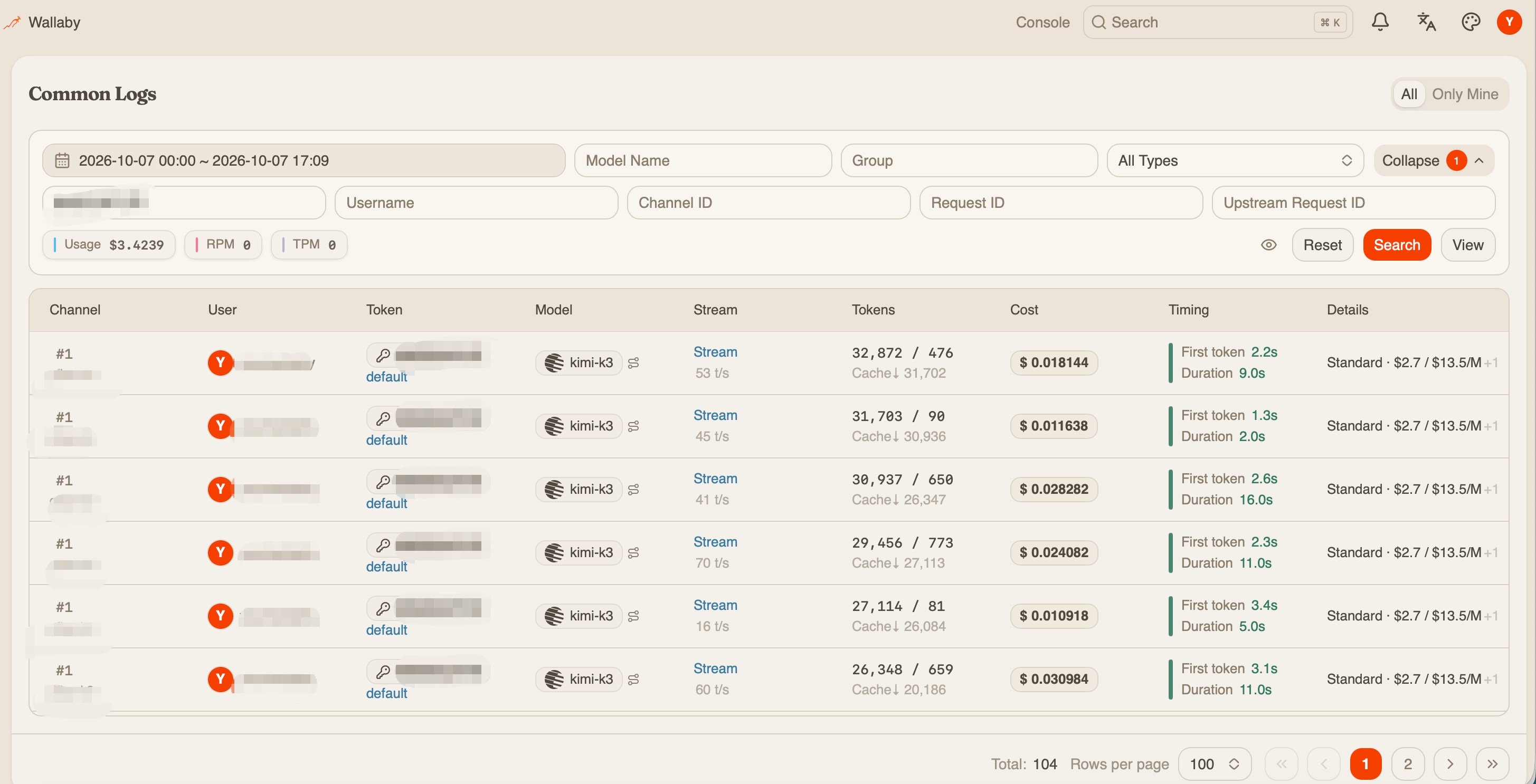
Finding 1: the ladder is real
Output volume and cost climb with each tier — $0.42 → $0.72 → $0.86 across Low, Medium, and Extra-high. The dial works, and it controls how much the model thinks.
This is worth stating plainly because we once believed the opposite. For thirteen days in September, our probe showed every tier producing identical output, and we concluded the model was ignoring the parameter. The truth was that our own router had been silently dropping it; we published that postmortem separately (Why did reasoning_effort silently stop working?). The four runs above are the cleanest evidence since the fix: the parameter passes through, and each tier is a measurably different amount of cognition.
Finding 2: "None" is not the savings tier
The run with no thinking budget — the tier Cline labels "None" — produced the most output (35.9K tokens) and the biggest bill ($1.43 — 3.4× the Low run). If you picked "None" expecting cheap, you get the opposite on a hard task.
The mechanism, on our gateway: none is a soft switch, not a hard cap. Easy prompts get suppressed thinking; hard prompts still think. Reviewing an unfamiliar repository is a hard prompt, so the model reasoned anyway — while also burning tokens on trial-and-error that a thinking budget would have shortened. Practical rule: to spend less, set Low. Do not reach for None.
Finding 3: what the extra thinking buys
We read all four reviews. The gradient is real, but concave.
The 38-line Low review is thin — and still caught the headline findings: two generations of the architecture coexisting, the repository failing its own automated health check, version markers that disagree with each other. Medium (92 lines) adds breadth; Extra-high (120 lines) is the most thorough, with the largest single response of the four runs at 9,812 tokens.
In this single experiment, the None run surfaced two real issues that none of the tiered runs caught: a script that only accepts English table headers, so non-English setups silently do nothing, and a cluster of stale copy contradicting current behavior. Genuinely useful catches — at 3.4× the price of the run that caught the big ones. Treat that as a one-off observation, not a pattern.
Our working ladder, for review-style tasks:
- Low for sweeps and triage — catch the headline risks at the lowest price
- Medium as the daily default for most review work
- Extra-high when the review itself is the deliverable
- None — never as a cost-saving move; it is not an economy setting
Finding 4: the number on your screen is not the bill
Cline's in-product cost display excludes cache-read charges. In the Medium round, the displayed $0.4683 matched fresh input (88.0K × $2.7/M) plus output (17.1K × $13.5/M) to the digit — the missing $0.256 was 947K cached tokens billed at $0.27/M, counted as free. Across all four rounds the display ran 21–37% below the gateway charge.
The root cause is tracked in Cline's issue tracker: the cost module supports a cache-read price, but the settings UI has no field to enter it, so it defaults to zero (cline#13944). Until that ships, budget from your provider's console, not from the extension.
Honest limits
One run per tier, one task type, one model. The None-versus-Extra-high gap includes ordinary variance, so treat the ordering as directional, not a law of nature — results may shift with a different prompt, repository, or model version. Lines of review are not a quality metric either — our quality claims rest on having read all four outputs, not on the line counts alone.
What we can say, because it is metered: the dial changes what you pay and how much thinking you get, the cheapest tier already earns its keep, and the tier called None was the most expensive of the four. If your agent exposes the same dial, the experiment costs less than a dollar to repeat — and your gateway bill will settle it better than anyone's vibes.
The opposite end of this dial also has a story: a session locked at maximum reasoning depth for a whole night, which cost us $51.77 on a single refactor.